What Is an Age Calculator?
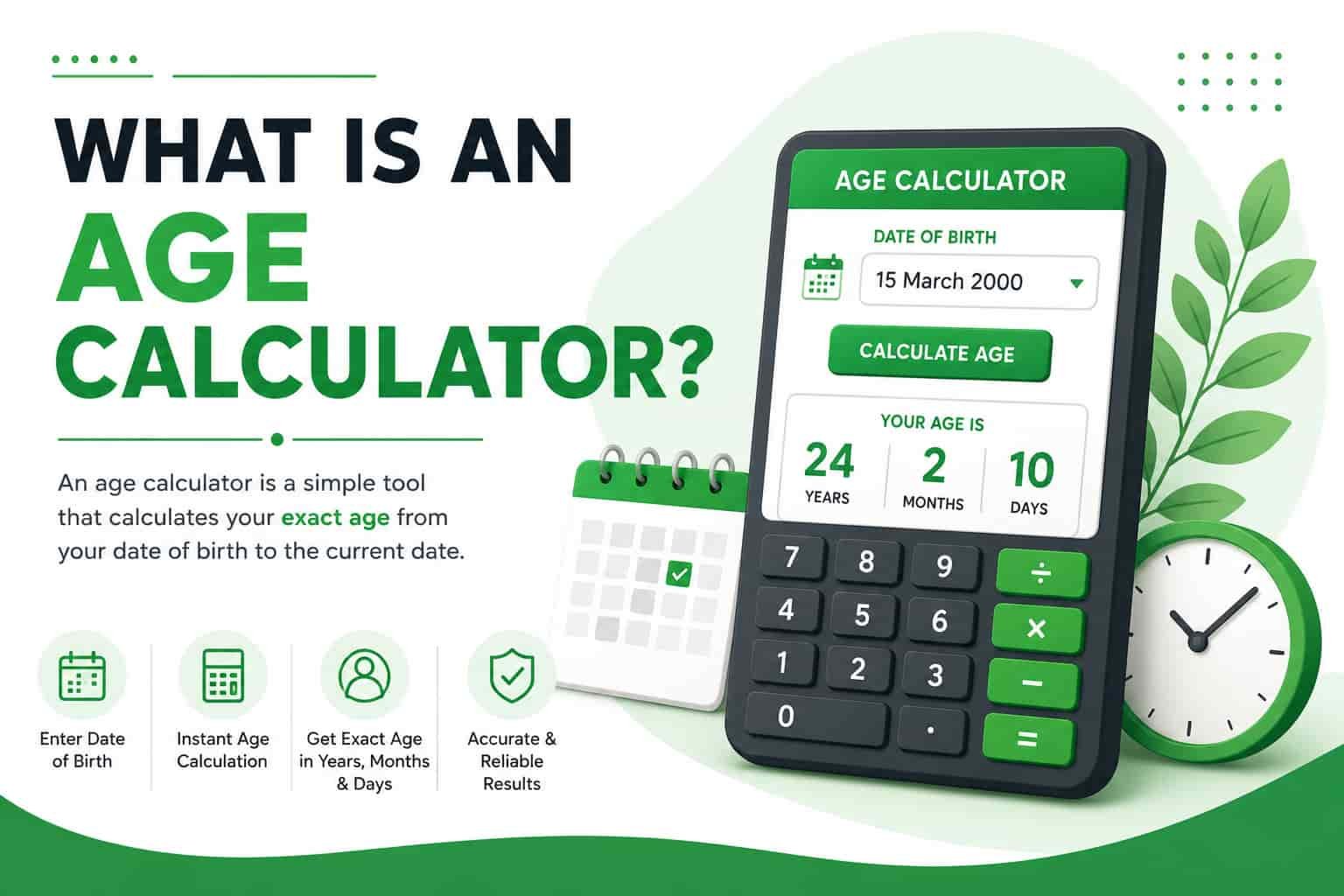
An age calculator is a digital tool that converts a birth date into an exact age, expressed in years, months, days, and smaller units of time. It removes manual counting from the equation and delivers a precise, error-free result in seconds.
Definition of an Age Calculator
An age calculator is a purpose-built application that measures the elapsed time between two dates. Consequently, it answers one specific question: how old is a person, an object, or an event on a given day. The tool accepts a date of birth as input and, in turn, returns a structured output that includes years, months, weeks, days, and often hours, minutes, and seconds.
Unlike a plain subtraction, an age calculator understands calendar logic. For instance, it accounts for months of different lengths and for leap years automatically. As a result, the output stays accurate no matter which dates you enter.
You can try the concept firsthand with our own free age calculator, which applies every rule described in this guide in real time.
How an Age Calculator Works
At its core, an age calculator performs a date-difference operation. First, it takes the start date, which is usually the date of birth. Then, it takes an end date, which defaults to today but can be set to any past or future date. After that, the tool subtracts the start date from the end date using calendar-aware logic, similar to long subtraction in base-60 and base-12 systems rather than base-10.
Because the Gregorian calendar governs most of the world, the calculation follows its rules for month lengths and leap years, a system explained in detail by Wikipedia’s overview of the Gregorian calendar. This approach aligns with the age-counting convention recognized internationally, including guidance referenced by the United Nations in population and demographic reporting.
A Simple Example
Suppose someone was born on 15 November 2006, and you want their age on 10 March 2026. The calculator borrows days and months where needed, then arrives at nineteen years, three months, and twenty-three days. Manually, this process takes a few careful steps. Digitally, it takes a fraction of a second.
The Anatomy of an Age Calculator
Every reliable age calculator is built from a consistent set of entities and attributes. Understanding these parts makes it easier to judge whether a tool is trustworthy.
| Attribute | Typical Value | Purpose |
|---|---|---|
| Input date | Day, month, year of birth | Establishes the starting point |
| Target date | Today or a chosen date | Sets the calculation endpoint |
| Calendar system | Gregorian calendar | Governs month length and leap years |
| Output units | Years, months, days, hours, minutes, seconds | Presents the result at multiple levels of detail |
| Derived data | Zodiac sign, generation, next birthday | Adds context beyond a single number |
Together, these attributes turn a simple subtraction into a complete age report rather than a single figure.
Types of Age Calculators
Not every age calculator solves the same problem. Therefore, several variations exist, each suited to a specific scenario.
- Standard age calculator. Converts a date of birth into a current age, down to the day.
- Date of birth calculator. Works in reverse, estimating a birth date from a known age. Our date of birth calculator handles this exact scenario.
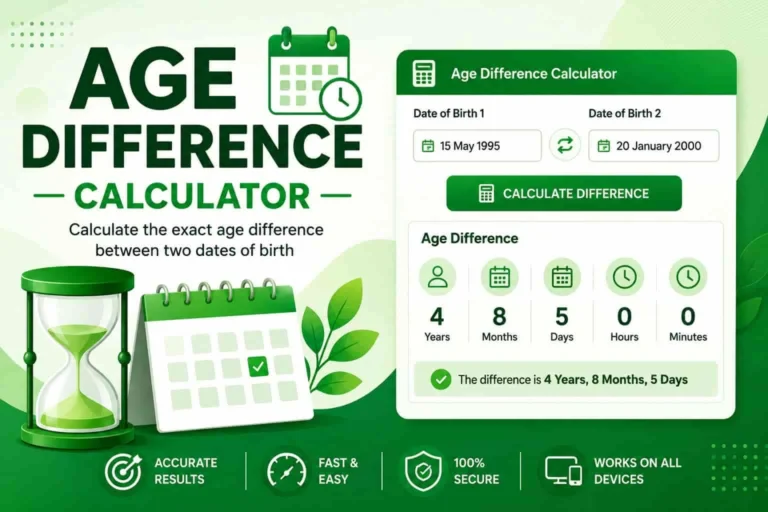
- Age difference calculator. Measures the gap between two people rather than one person and today. You can test this with our age difference calculator.
- Future age calculator. Projects age on a date years ahead, which helps with long-term planning. See our how old will I be tool for this purpose.
Who Relies on an Age Calculator
A wide range of people turn to an age calculator, and each group has a distinct reason for doing so.
Students and Parents
Admission committees frequently set age cut-offs for school and university programs. Meanwhile, parents track a newborn’s age in weeks or months rather than years. In both cases, an age calculator delivers the answer instantly.
Job Seekers and Exam Candidates
Government positions, competitive exams, and recruitment drives, such as the CSS exam age limit in Pakistan, all depend on strict age brackets. Consequently, applicants check their eligibility before they invest time in a form.
Researchers and Record Keepers
Genealogists and historians often calculate a person’s age on a historical date. Since manual calculation invites error, a dedicated tool keeps the record precise.
Core Benefits
An age calculator earns its place as a daily-use tool for several clear reasons.
- Speed. A complete result appears in seconds, not minutes.
- Precision. The tool applies leap-year and month-length rules without fail, every single time.
- Depth. Beyond a single number, you receive total days, weeks, hours, and even a next-birthday countdown.
- Accessibility. Most tools require no signup, no download, and no fee, so anyone can use one immediately.
Why Accuracy Matters
Manual age counting fails more often than people expect, mainly because February changes length every four years. The NASA Space Place explainer on leap years outlines exactly why this extra day exists and how it keeps the calendar aligned with Earth’s orbit. An age calculator bakes this rule into every calculation, so the result never drifts off by a day, even across multiple leap years.
Furthermore, official processes rarely forgive a miscalculated age. A single day of error can shift eligibility for a government job, an exam, or a legal milestone. Consequently, a dependable calculator is not a convenience; it is a safeguard against costly mistakes.
Related Tools You May Find Useful
Frequently Asked Questions
What is an age calculator used for?
An age calculator finds the exact time between a birth date and any chosen date, expressed in years, months, days, and smaller units such as hours or seconds.
Is an age calculator accurate?
Yes. A well-built age calculator applies Gregorian calendar rules, including leap years, so it avoids the small errors that manual counting often produces.
Can an age calculator work out the gap between two dates?
Yes. Instead of using today as the end date, you can select any past or future date to measure the exact interval between two points in time.
Ready to Find Your Exact Age?
Enter your date of birth and get a complete, accurate age report in seconds, with no signup required.
Try the Age CalculatorSources
- Wikipedia — Gregorian Calendar
- NASA Space Place — Why Do We Have Leap Years?
- United Nations — un.org