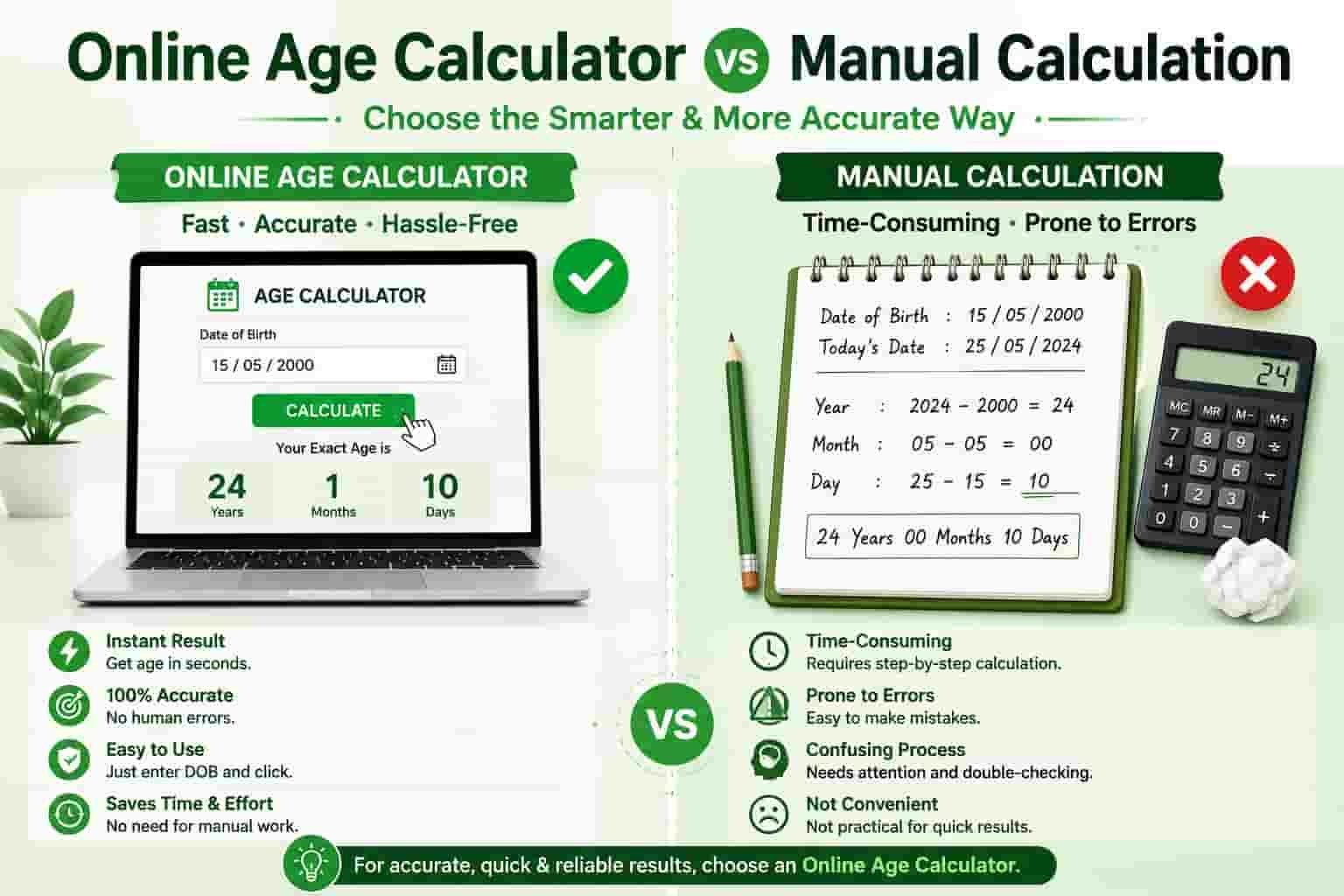
Online Age Calculator vs Manual Calculation
Working out an age sounds simple until leap years, month lengths, and cut-off dates get involved. Here’s a direct comparison of using an online age calculator versus doing the math by hand — and when each approach actually makes sense.
Quick Overview
Both approaches try to answer the same question: how much time has passed since a given date of birth. However, they get there very differently. Manual calculation relies on a person doing subtraction in their head or on paper, while an online age calculator runs the same logic through code that never forgets a rule or gets tired halfway through.
Try it yourself with our own free age calculator, and compare the result against your own manual attempt using the method described below.
Side-by-Side Comparison
| Factor | Online Calculator | Manual Calculation |
|---|---|---|
| Speed | Instant | 30 seconds to a few minutes |
| Leap year handling | Automatic, always correct | Easy to forget or miscount |
| Month-length accuracy | Handled by calendar logic | Requires memorizing days per month |
| Risk of human error | Very low | Moderate to high |
| Works without internet | Usually requires a connection | Always available |
| Output detail | Years, months, days, and more | Typically just years |
| Best for | Official forms, exams, legal use | Quick mental estimates |
How Manual Calculation Works
The standard manual method follows a short sequence. First, subtract the birth year from the current year. Then, check whether the current month and day fall before the birth month and day. If they do, subtract one more year, since the birthday hasn’t happened yet. This gets you the age in whole years.
For a more precise result down to months and days, you then have to subtract the birth month and day from the current month and day separately, borrowing a month or a day when the subtraction goes negative — which is exactly the step most people skip or get wrong.
Where Manual Calculation Fails
Three mistakes account for almost every manual calculation error.
- Forgetting the birthday check. Subtracting birth year from current year without checking whether the birthday has passed silently adds an extra year.
- Ignoring leap years. February’s extra day, explained by the NASA Space Place leap year guide, throws off day-level precision if it isn’t accounted for.
- Miscounting month lengths. Borrowing days across months of 28, 29, 30, or 31 days is easy to get wrong without a reference.
How an Online Calculator Works
An online age calculator performs the same subtraction as the manual method, but it applies Gregorian calendar rules — outlined in detail on Wikipedia’s Gregorian calendar overview — consistently, every single time. It never forgets to check the birthday, never miscounts a month, and never skips a leap year.
Beyond the basic year count, most tools also return months, days, and sometimes total days or hours — a level of detail that would take much longer to work out by hand.
When to Use Each Method
Use an Online Calculator When
- Applying for a job, exam, or program with an age cut-off
- Filling out legal or official documents
- You need age broken down to months or days
- Accuracy genuinely matters
Manual Math Is Fine When
- You just want a rough number for conversation
- You don’t have internet access
- Being off by a day or two has no consequence
- You’re double-checking a calculator’s result
A Case Where They Disagree
Suppose someone was born on 29 February 2000, and you’re calculating their age on 28 February 2026, a non-leap year. A quick manual subtraction might just say “26 years” without a second thought.
An online calculator, however, follows a defined convention for this edge case — typically treating 28 February as the equivalent birthday in non-leap years — and returns a precise, consistent answer rather than a guess. This kind of edge case is exactly where manual calculation quietly breaks down.
Related Tools You May Find Useful
Frequently Asked Questions
Is an online age calculator more accurate than manual calculation?
Yes, in practice. An online age calculator applies calendar rules, including leap years, consistently every time, while manual calculation depends on the person remembering every rule correctly.
When is manual age calculation good enough?
Manual calculation works fine for a rough, everyday estimate where being off by a few days doesn’t matter, such as casual conversation.
Why do manual and online results sometimes differ?
The most common cause is forgetting to check whether the birthday has occurred yet in the current year, or miscounting days across months of different lengths.
Skip the Manual Math
Get your exact age in years, months, and days in seconds, with no signup required.
Try the Age CalculatorSources
- Wikipedia — Gregorian Calendar
- NASA Space Place — Why Do We Have Leap Years?