AGE CALCULATOR GUIDES • BODY COMPOSITION
Body Fat Calculator: How to Estimate Body Fat Percentage
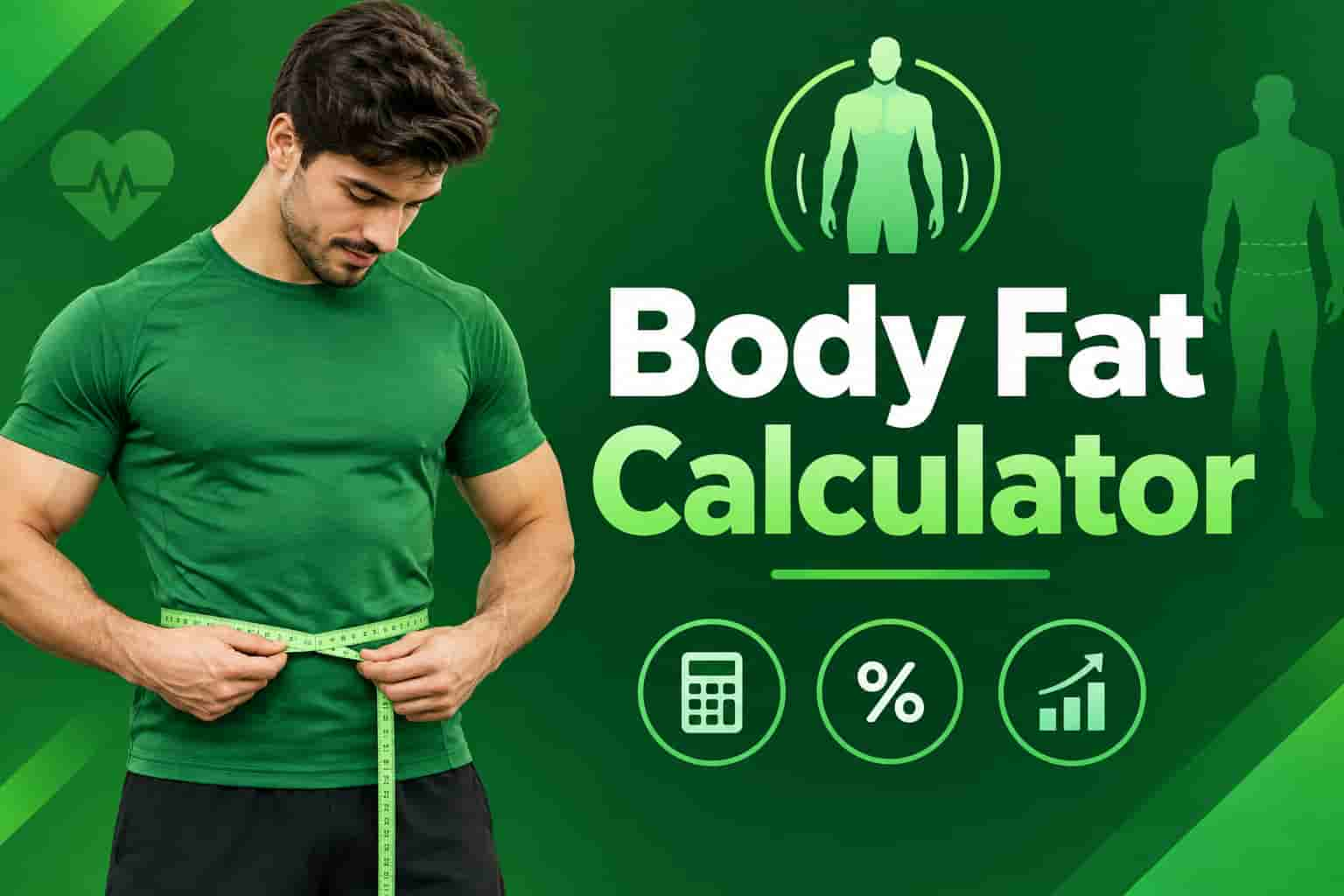
A Body Fat Calculator estimates how much of a person’s body weight consists of fat. This guide explains how body-fat estimates work, common measurement methods, why results vary, and when a professional assessment may be more useful. A number alone cannot determine someone’s health.
1. What Is a Body Fat Calculator?
A body fat calculator is an estimation tool that expresses body fat as a percentage of total body weight. Body fat is a normal and essential part of the human body. It supports functions such as energy storage, temperature regulation, and protection of organs.
Online calculators may use height, weight, age, or body measurements. They are convenient, but they do not directly measure fat tissue. Results should be understood as approximations rather than diagnoses or judgments about appearance.
2. How Does a Body Fat Calculator Work?
Different calculators use different equations. Some estimate body composition from measurements such as waist and neck circumference; others use body mass index (BMI) and demographic inputs. The accuracy of each approach depends on the population for which the equation was developed.
Typical Calculation Process
- Identify the estimation method used by the calculator.
- Enter the requested measurements in the correct units.
- Check that measurements were taken consistently.
- Read the resulting percentage as an estimate, not an exact value.
- Consider the method’s limitations before drawing conclusions.
Important: Adult prediction equations and reference ranges may not be appropriate for children and teenagers, whose bodies are still developing. A qualified healthcare professional can interpret measurements in the context of growth and health.
3. Common Methods of Estimating Body Fat
| Method | How It Works | Main Limitation |
|---|---|---|
| Body measurement equations | Use circumference measurements and mathematical formulas. | Results depend on the equation and measurement technique. |
| Bioelectrical impedance (BIA) | Estimates body composition using electrical resistance. | Hydration and device conditions affect readings. |
| Skinfold measurements | Use calipers at selected body sites. | Operator skill and formula selection matter. |
| DXA scan | Uses low-dose X-rays to estimate body composition. | Requires specialist equipment and interpretation. |
Are Professional Methods Exact?
No method is completely error-free. Even laboratory techniques use assumptions and have measurement uncertainty. A professional can help select an appropriate method and explain what the results do—and do not—mean.
4. Understanding a Body Fat Percentage Calculation
The basic definition is:
Body Fat Percentage = (Fat Mass ÷ Total Body Mass) × 100
For a purely mathematical illustration, if a hypothetical object had a total mass of 50 units and 10 units were classified as fat mass, the proportion would be (10 ÷ 50) × 100 = 20%. In real people, fat mass generally must first be estimated by a measurement method; it cannot be determined from total weight alone.
5. How Accurate Are Online Body Fat Calculators?
Online body fat calculators provide convenient estimates, but their precision varies. Two calculators can return different results for the same person because their formulas and assumptions differ. Individual differences in body composition can also affect estimates.
Measurement errors, inconsistent units, and using equations outside their intended populations can make the result less reliable. Avoid treating small differences between estimates as meaningful changes in health.
6. Body Fat Percentage vs BMI
BMI relates weight to height, while body fat percentage describes the estimated proportion of fat tissue. Neither number alone provides a complete picture of physical health.
| Feature | Body Fat Percentage | BMI |
|---|---|---|
| What it represents | Estimated proportion of body fat | Weight relative to height |
| Typical inputs | Depend on the method | Height and weight |
| Key limitation | Measurement and equation uncertainty | Does not directly measure body composition |
Read our related BMI Calculator guide for more information about what BMI measures.
7. Factors That Affect Body Fat Estimates
Several factors can influence measurements and their interpretation, including hydration, recent meals, measurement technique, device calibration, age, growth stage, and the population used to develop the equation.
Body composition naturally differs among individuals and changes throughout life. There is no single percentage that describes health for everyone.
8. How to Use Body Fat Calculator Results Responsibly
Use the result as general educational information rather than a target to chase. Physical health also involves energy, sleep, physical function, medical history, and many other factors that an online calculator cannot assess.
If you have questions about growth, nutrition, or a measurement result, speak with a qualified healthcare professional. For additional general educational resources, explore the Age Calculator homepage.
9. Frequently Asked Questions
What is a body fat calculator?
It is a tool that estimates the percentage of body mass consisting of fat using a specified method or equation.
Can an online calculator measure body fat exactly?
No. Online tools generally predict body fat from indirect measurements and have a margin of error.
Is body fat the same as BMI?
No. BMI is calculated from height and weight, while body fat percentage estimates a component of body composition.
Why do different calculators give different answers?
They may use different equations, inputs, assumptions, and reference populations.
Are adult body fat formulas suitable for teenagers?
Not necessarily. Growth and development affect body composition, so adult equations may be inappropriate. A healthcare professional can provide age-appropriate guidance.
Does a body fat percentage determine whether someone is healthy?
No. It is one estimate and cannot independently establish overall health or fitness.
10. Conclusion
A Body Fat Calculator can help explain the concept of body composition, but every result should be interpreted with care. Understanding the estimation method, its uncertainty, and the limits of any single number is more useful than treating the output as a definitive assessment of health.
Disclaimer: This article is for general educational purposes and is not medical advice.