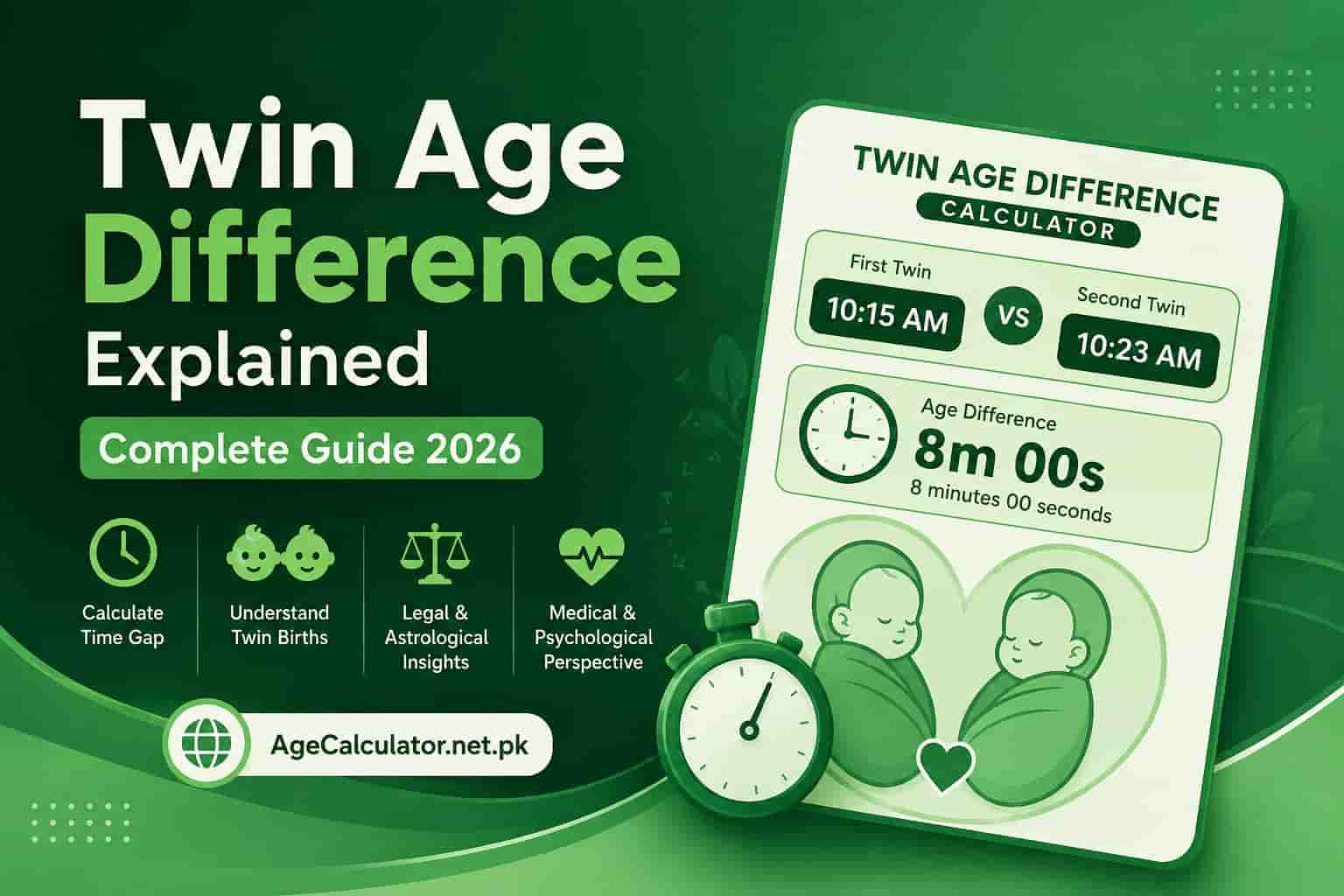
Twin Age Difference Explained
Twins can have different recorded birth times even when they share a birthday. Compare two birth records to calculate the time gap in days, hours and minutes. This guide explains what that gap means for calendar age and what it does not imply about development or identity.
Use the Twin Age Difference Explained
How the calculation works
Enter both dates and times from records using the same clock and time zone. The tool subtracts the first timestamp from the second as wall-clock values, without applying a daylight-saving transition. A birth across midnight is handled by the different date entered for the second twin.
Worked example
Birth times of 10:05 and 10:18 on the same date are 13 minutes apart. Births at 23:58 and 00:03 on consecutive dates are five minutes apart even though the twins have different calendar birthdays.
Different birthdays and the same pregnancy
Twins born on opposite sides of midnight can have different day numbers in their records. That is a calendar boundary, not evidence that they belong to different pregnancies. Preserve the dates and times shown by the original records.
Calendar age and corrected age
For most date-based forms, the recorded birth date determines calendar age. Premature-birth context may require corrected age for developmental discussion, which is a separate calculation. Ask the care team which age convention is appropriate rather than using the twin-time gap as a correction.
Important limitations
The tool uses minute precision because the input does not contain seconds. It cannot infer an unrecorded time or account for clocks that were changed between births. If the records use different time zones, convert them to the same zone first. A small birth-time gap does not by itself explain medical differences.
Frequently asked questions
Can twins have different birthdays?
Yes, if their recorded births fall on different calendar dates.
Does the earlier birth time establish maturity?
No. The tool compares timestamps only.